

What Is Panko? Japanese Breadcrumbs Explained

Crispy tonkatsu, golden chicken katsu and crunchy ebi fry all have one important ingredient in common: panko.
You may have seen bags labelled “Panko” or “Panko Breadcrumbs” in UK supermarkets and wondered: what is panko, what is it made from, and how is it different from ordinary breadcrumbs?
Panko is the Japanese word for breadcrumbs and is widely used to create crisp coatings for dishes such as katsu, ebi fry and korokke. Japan’s Ministry of Agriculture, Forestry and Fisheries (MAFF) defines breadcrumbs under the Japanese Agricultural Standards as a food made by preparing a bread mixture using ingredients such as wheat flour and yeast, fermenting and heating it, and then breaking it down into crumbs.
Source: Ministry of Agriculture, Forestry and Fisheries of Japan (MAFF), Japanese Agricultural Standard information for breadcrumbs. View the MAFF document
In this guide, we explain what panko is, what panko is made from, how panko compares with regular breadcrumbs, why breadcrumb size matters for crispness, and how to use panko at home for Japanese favourites such as katsu and ebi fry.
Table of Contents
- ■ What Is Panko?
- ■ What Is Panko Made Of?
- ■ Panko vs Breadcrumbs: What’s the Difference?
- ■ Why Is Panko So Crispy?
- ■ How Is Panko Used in Japanese Cooking?
- ■ Can You Use Panko for Katsu?
- ■ How to Use Panko Breadcrumbs at Home
- ■ Can Panko Be Used Beyond Fried Food?
- ■ Can You Use Panko Instead of Regular Breadcrumbs?
- ■ Where to Buy Panko in the UK
- ■ Frequently Asked Questions About Panko
- ■ Sources
■ What Is Panko?
Panko is the Japanese word for breadcrumbs. In the UK and other English-speaking countries, the word is commonly used for Japanese-style breadcrumbs, especially products designed to create a light, textured coating for fried foods.
Under Japan’s agricultural standards, breadcrumbs are made by preparing a bread mixture using ingredients such as wheat flour and yeast, fermenting and heating it, and then breaking it down into crumbs. The standard also recognises the shape and size of breadcrumb particles as an important quality characteristic.
Source: Ministry of Agriculture, Forestry and Fisheries of Japan (MAFF). Read the Japanese Agricultural Standard information
In everyday British English, it is useful to think of the relationship like this:
Panko is especially associated with Japanese breaded dishes such as tonkatsu, chicken katsu, ebi fry and korokke, where the coating adds an important contrast to the softer food inside.
■ What Is Panko Made Of?

Panko is made from bread, with wheat flour and yeast among the core ingredients commonly used to make the bread before it is turned into crumbs.
MAFF’s Japanese Agricultural Standard defines breadcrumbs as a product made from wheat flour, or wheat flour combined with other cereal flours, with yeast and other permitted ingredients. The mixture is kneaded, fermented, heated and then broken down into crumbs.
Source: Ministry of Agriculture, Forestry and Fisheries of Japan (MAFF). View the MAFF document
Not every panko product has exactly the same recipe. Depending on the product, breadcrumbs may contain other permitted ingredients, and the moisture level and crumb size can also differ.
Japanese standards distinguish between three broad types:
- Dry breadcrumbs – breadcrumbs dried to a moisture level of 14% or less.
- Fresh breadcrumbs – breadcrumbs that have not been dried.
- Semi-dry breadcrumbs – breadcrumbs with a moisture level between the two.
So rather than thinking of panko as one single fixed recipe, it is more accurate to think of it as a breadcrumb product whose ingredients, moisture level and particle characteristics can vary depending on the type and manufacturer.
■ Panko vs Breadcrumbs: What’s the Difference?

Panko is a type of breadcrumb, rather than a completely separate food. The practical difference shoppers notice most often is the shape and size of the crumbs and the texture they create when used as a coating.
MAFF’s standard treats breadcrumb particle shape and size as a quality characteristic. In the UK, products sold as Japanese-style panko often emphasise a flaky, textured crumb designed for crisp coatings.
| Panko / Japanese-Style Breadcrumbs | Regular Breadcrumbs | |
|---|---|---|
| Food category | A type of breadcrumb | Breadcrumbs |
| Crumb | Often sold with a more noticeable flaky or coarse texture | Varies by product; many are more finely crumbed |
| Coating | Can create a visibly textured surface | Can create a finer, more even coating depending on the product |
| Texture | Often chosen when a crisp, crunchy finish is wanted | Depends on crumb size and cooking method |
| Japanese dishes | Tonkatsu, chicken katsu, ebi fry, korokke and more | Used across a wide range of cuisines and dishes |
Source: MAFF’s breadcrumb standard identifies particle shape and size as quality characteristics of breadcrumbs. View the MAFF document
So when asking “panko vs breadcrumbs – what is the difference?”, the simplest answer is that panko belongs to the breadcrumb family, but Japanese-style panko is commonly chosen for its distinctive crumb structure and the coating it creates.
■ Why Is Panko So Crispy?
Breadcrumb particle size is one of the factors that can influence how crisp a fried coating feels.
A peer-reviewed study examining breadcrumb coatings with different particle sizes found that smaller breadcrumb particles were associated with lower sensory crispness, while larger breadcrumb particles were associated with stronger crispness and differences in the structure of the fried coating.
Source: Peer-reviewed research on breadcrumb particle size and fried coating texture, available via PubMed Central. View the research paper
This helps explain why a more noticeable breadcrumb structure can make such a difference to dishes such as katsu. The crumb creates texture on the outside of the food, contrasting with the meat, seafood or vegetables inside.
However, breadcrumb size is only one part of the result. Crispness also depends on factors such as how the coating is applied, the food being cooked, moisture, cooking temperature and cooking time. Panko should therefore be understood as an important tool for creating a crisp coating rather than a guarantee that every dish will turn out the same way.
■ How Is Panko Used in Japanese Cooking?

Panko is used in a range of Japanese dishes, particularly breaded fried foods.
・ Tonkatsu
Tonkatsu is one of the best-known examples. Pork is coated before frying, creating a crisp outer layer around the meat.
MAFF’s regional recipe for katsudon describes coating pork with flour, egg and breadcrumbs before frying it. This basic coating method is closely associated with Japanese cutlet dishes.
Source: Ministry of Agriculture, Forestry and Fisheries of Japan (MAFF), regional katsudon recipe. View the MAFF katsudon source
・ Chicken Katsu
Chicken katsu follows the same general idea, using chicken instead of pork.
For many people in the UK, one of the most familiar ways to enjoy it is chicken katsu curry: crisp breaded chicken served with Japanese curry and rice.
It is also a useful first dish if you are trying panko at home because the coating is a major part of the finished texture.
・ Ebi Fry
Ebi fry is a Japanese yoshoku dish made by coating prawns with flour, beaten egg and breadcrumbs before frying.
Japan’s Government Public Relations material describes ebi fry as prawns coated with flour, beaten egg and breadcrumbs and then fried in oil, and identifies it as a Japanese-developed yoshoku dish.
Source: Government of Japan, Public Relations Office. View the government source
The contrast between the firm, juicy prawn and crisp breadcrumb coating makes ebi fry another clear example of why breadcrumb texture matters.
・ Korokke
Korokke, Japanese croquettes, are another well-known breaded yoshoku dish. A soft filling, often based on potato, is shaped and coated before frying.
MAFF’s food-culture material discusses dishes including cutlets, croquettes and ebi fry as part of the development and spread of yoshoku in Japan.
Source: Ministry of Agriculture, Forestry and Fisheries of Japan (MAFF), information on Japanese food culture. View the MAFF source
■ Can You Use Panko for Katsu?
Yes. Panko is an excellent breadcrumb to use for Japanese katsu.
The basic coating method is straightforward:
MAFF’s katsudon recipe follows the same basic sequence of flour, egg and breadcrumbs when coating pork before frying.
Source: Ministry of Agriculture, Forestry and Fisheries of Japan (MAFF), katsudon recipe. View the MAFF recipe
Panko itself is mainly there to create the outer coating, so the finished dish can then be paired with tonkatsu sauce, Japanese curry or other accompaniments.
If you are new to Japanese cooking, chicken katsu curry is an approachable place to start.
■ How to Use Panko Breadcrumbs at Home

If you are using panko for the first time, a simple breaded dish is the easiest way to understand how it works.
Step 1: Prepare the Ingredient
Prepare the chicken, pork, prawns, fish or vegetables you want to coat.
Step 2: Coat Lightly with Flour
Cover the surface with a light layer of flour.
Step 3: Dip in Beaten Egg
Dip the floured ingredient into beaten egg so the surface is coated.
Step 4: Coat with Panko
Cover the ingredient with panko, making sure the crumbs are distributed across the surface.
Step 5: Cook Thoroughly
Cooking temperature and time depend on the ingredient and its thickness. When cooking meat, fish or prawns, follow an appropriate recipe and make sure the food is fully and safely cooked before serving.
The familiar flour → egg → panko structure is also reflected in MAFF’s recipe guidance for breaded Japanese dishes such as katsudon.
■ Can Panko Be Used Beyond Fried Food?

Yes. Panko does not have to be used only as a coating for fried food.
Because it adds texture, panko can also be toasted and used as a crunchy topping. Depending on the dish, you can try it with:
- salads
- baked vegetables
- gratin
- pasta dishes
- oven-baked fish
For example, Yutaka Panko Japanese Style Breadcrumbs can be tossed with olive oil and toasted in a frying pan or oven to make a crispy topping.
This makes panko useful not only for Japanese breaded dishes but also whenever you want to add a little extra crunch to a meal.
■ Can You Use Panko Instead of Regular Breadcrumbs?
In many recipes, yes – but the finished texture may be different.
Because panko is itself a type of breadcrumb, it can often be used in places where breadcrumbs are required. However, differences in particle shape and size can change the appearance and texture of the finished coating.
Research into breadcrumb particle size shows that changing crumb size can influence the structure and perceived crispness of fried coatings.
Source: Peer-reviewed research on breadcrumb particle size and coating texture. View the research paper
- Want a more visibly textured, crunchy coating? Try panko.
- Want a finer, more even crumb? A finer breadcrumb may suit the recipe better.
Neither option is automatically better for every dish. The best choice depends on the result you want.
■ Where to Buy Panko in the UK
Panko can be found in the UK through Japanese and Asian food retailers, supermarkets and specialist online shops.
Yutaka Shop Online offers Yutaka Panko Japanese Style Breadcrumbs 180g, a light, flaky breadcrumb designed for dishes such as katsu, fried prawns and breaded fish.
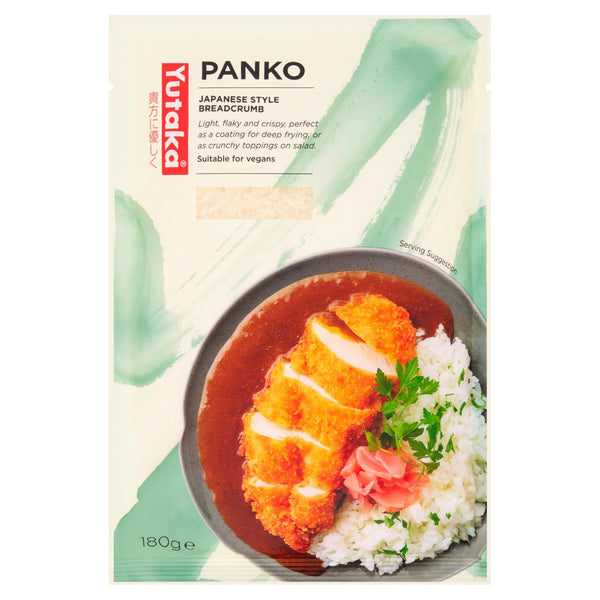
Yutaka Panko Japanese Style Breadcrumbs 180g
Light, flaky Japanese-style breadcrumbs for adding a crisp coating to dishes such as chicken katsu, tonkatsu, fried prawns and breaded fish.
The ingredients are wheat flour (98%), yeast and salt. The product is listed as vegan and contains wheat.
It can also be toasted with a little olive oil and used as a crunchy topping for other dishes.
Shop Yutaka PankoAlways check the individual product page and packaging for the latest ingredient, allergen, preparation and storage information before use.
■ Frequently Asked Questions About Panko
What is panko?
Panko is the Japanese word for breadcrumbs. In the UK, the term is commonly used for Japanese-style breadcrumbs, particularly the type used to create textured coatings for dishes such as katsu and ebi fry.
What are panko breadcrumbs?
Panko breadcrumbs are Japanese-style breadcrumbs. Panko belongs to the same broad food category as other breadcrumbs, but products sold as panko often have a distinctive crumb structure intended to create a crisp coating.
What is panko made of?
Breadcrumbs are made from bread. MAFF’s Japanese Agricultural Standard defines them as a product made by preparing and fermenting a bread mixture using ingredients such as wheat flour and yeast, heating it and then breaking it down into crumbs. Exact ingredients vary by product. Source: MAFF.
What is the difference between panko and breadcrumbs?
Panko is a type of breadcrumb. The difference shoppers commonly notice is the crumb structure: Japanese-style panko is often chosen for a more textured coating, while other breadcrumbs may be more finely crumbed. Particle size can also affect the texture of a fried coating.
Why is panko so crispy?
Breadcrumb particle size is one factor that influences the crispness of a fried coating. Peer-reviewed research found that changes in breadcrumb particle size affected coating structure and sensory crispness. Cooking method, moisture and temperature also matter. View the research.
Can you use panko for katsu?
Yes. Panko is well suited to Japanese katsu. A common coating method is flour, followed by beaten egg and then breadcrumbs before cooking. MAFF’s katsudon recipe uses this same basic coating sequence. Source: MAFF.
Is panko used for ebi fry?
Yes. Ebi fry is made by coating prawns with flour, beaten egg and breadcrumbs before frying. It is a well-known Japanese yoshoku dish. Source: Government of Japan.
Can I use panko instead of regular breadcrumbs?
In many recipes, yes. However, the finished coating may look and feel different because breadcrumb particle shape and size can affect texture. Choose according to the result you want.
How do you use panko breadcrumbs?
For breaded dishes such as katsu, a simple method is to coat the food with flour, dip it in beaten egg, then cover it with panko before cooking it thoroughly. Panko can also be toasted and used as a crunchy topping.
■ Discover the Crunch of Japanese Panko
Panko may look like a simple pantry ingredient, but it plays an important role in the texture of many familiar Japanese dishes.
The crisp coating around tonkatsu, the crunch of chicken katsu and the contrast between juicy prawns and the outside of ebi fry all show how much difference breadcrumbs can make.
Japanese yoshoku developed by adapting Western-style dishes to Japanese tastes and cooking culture, and breaded dishes such as cutlets, croquettes and ebi fry became part of that tradition.
Source: Ministry of Agriculture, Forestry and Fisheries of Japan (MAFF), information on the development of Japanese food culture. View the MAFF source
If you are new to panko, try starting with chicken katsu, tonkatsu or ebi fry. Once you are familiar with it, you can also use panko for fish, vegetables and crunchy toppings.
■ Sources
-
Ministry of Agriculture, Forestry and Fisheries of Japan (MAFF) – Japanese Agricultural Standard information for breadcrumbs
Definition of breadcrumbs, permitted ingredients, moisture classifications and quality characteristics including crumb shape and size.
View the MAFF document -
Ministry of Agriculture, Forestry and Fisheries of Japan (MAFF) – Katsudon, Yamanashi
Example of the flour, egg and breadcrumb coating method used for Japanese breaded pork.
View the MAFF source -
Government of Japan, Public Relations Office – Japanese Yoshoku
Information describing ebi fry as prawns coated with flour, beaten egg and breadcrumbs and fried in oil.
View the government source -
Ministry of Agriculture, Forestry and Fisheries of Japan (MAFF) – Food Culture
Information on the development and spread of yoshoku dishes in Japan, including cutlets, croquettes and ebi fry.
View the MAFF source -
Peer-Reviewed Research – Breadcrumb Particle Size and Fried Coating Texture
Research examining how breadcrumb particle size influences the structure and sensory crispness of fried coatings.
View the research paper